
Alright, let’s get straight into it. You’re sourcing or specifying condensing units for a project, a client, or your inventory. The big fork in the road: air-cooled or water-cooled. This isn’t just a technical checkbox; it’s a fundamental business decision that ripples through cost sheets, operational plans, and client relationships. The right choice for a Dubai high-rise is a financial disaster for a Copenhagen data center. Let’s break down where each system wins, loses, and drives profit.

The Core Trade-Off: Upfront Spend vs. Operational Grit
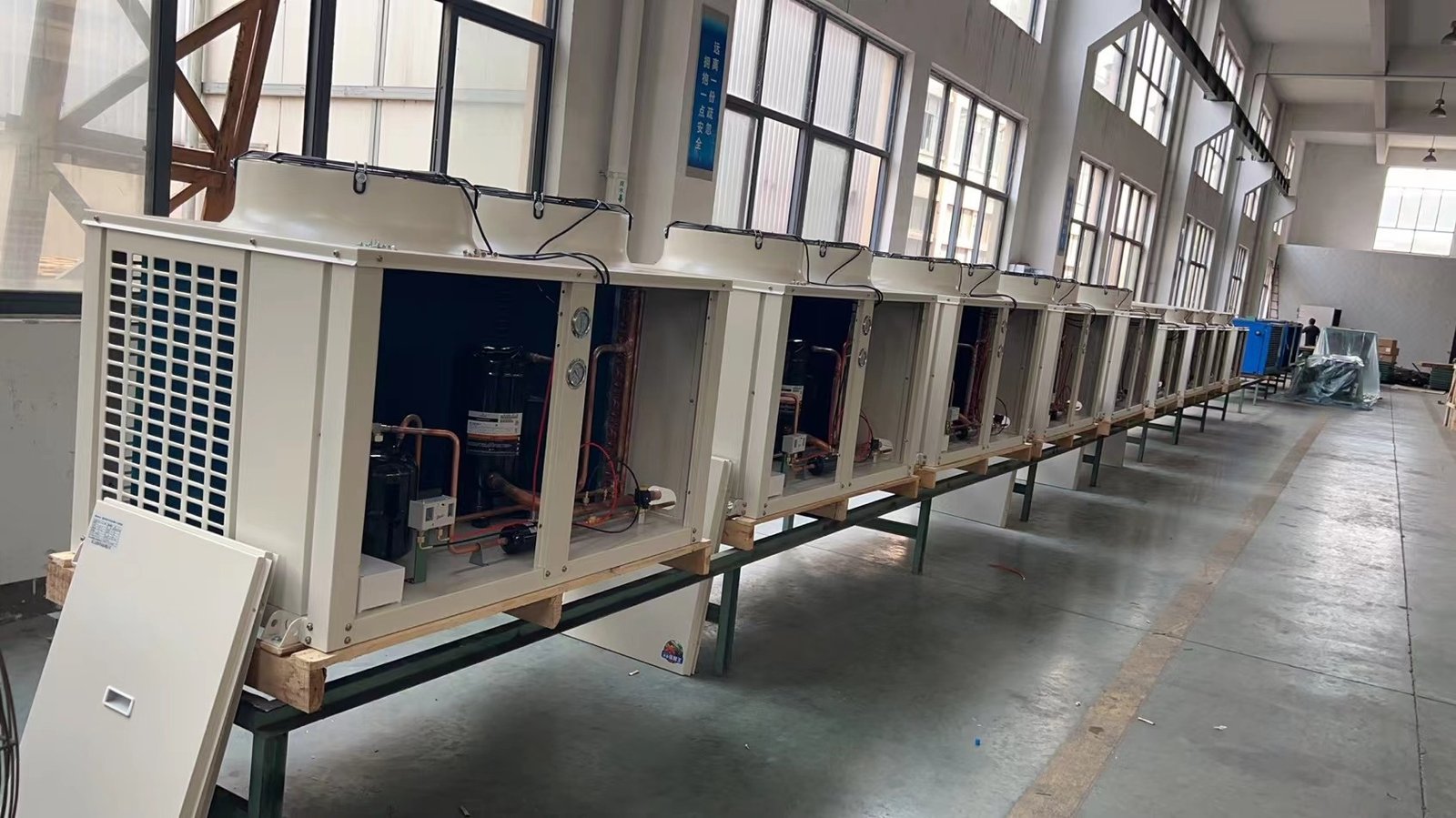
Think of this as the capital expenditure (CapEx) versus operational expenditure (OpEx) showdown. Air-cooled units are the straightforward play. The system is self-contained: a condenser coil and fans that reject heat directly to the atmosphere. You’re buying a simpler piece of kit. Water-cooled units are more complex. They use water (usually in a circuit with a cooling tower) to absorb and reject heat. More components—the unit itself, pumps, cooling towers, water treatment systems—mean a higher initial price tag.

But here’s the twist. Water is a vastly more efficient heat transfer medium than air. This means a water-cooled condensing unit typically consumes significantly less electrical energy to do the same amount of cooling. So, you pay more at the dock, but your client’s monthly utility bill takes a dive.
Real-time Market Pulse (2024): With global industrial electricity prices volatile but trending upward, the OpEx savings of water-cooled systems are getting sharper teeth. However, in regions facing severe water scarcity or with high water tariffs, the equation tilts back. The “cheaper to install” advantage of air-cooled units remains a powerful driver for projects with tight initial budgets or shorter-term horizons.
H2: Conquering the Commercial Landscape: Skyscrapers, Malls, and Hospitals
Walk through any major city’s downtown. The condensing units on those buildings are silently declaring their economic logic.
For large commercial facilities like regional hospitals, flagship malls, or 50-story office towers, water-cooled systems are often the undisputed champion. The sheer cooling demand makes energy efficiency the paramount king. The higher efficiency (measured in kW/ton or COP) translates directly into millions of saved kilowatt-hours annually. The physical footprint is another win: the condensing unit itself is more compact, and the cooling tower can be placed on the roof, freeing up valuable ground-level or mechanical room space for revenue-generating uses.
But look at suburban strip malls, smaller clinics, or apartment blocks. Here, air-cooled units dominate. Why? Lower installation complexity means faster project completion. No need for water pipes, chemical treatment systems, or elaborate tower maintenance contracts. For a property management firm overseeing dozens of such properties, the simplicity, predictability of maintenance (filter changes, coil cleaning), and lack of water risk (no freezing or Legionella concerns) make it the pragmatic, lower-total-responsibility choice for distributors to stock and recommend.
H2: The Industrial Heartbeat: Manufacturing, Processing, and Data
This is where the heat loads get serious, and the choice impacts production continuity.
In process industries—food & beverage, pharmaceuticals, chemical plants—where precise, constant cooling is married to high heat output, water-cooled systems are the workhorse. Their ability to maintain stable condensing temperatures even in high ambient conditions ensures process machinery runs consistently. For a German beverage plant running 24/7, the energy savings pay back the premium in a few years. The noise advantage is also critical inside plants where operator communication matters.
The data center industry presents a fascinating split. Traditional large-scale data centers have long relied on water-cooled chillers for their brutal efficiency. But the rise of modular, edge data centers—smaller facilities located closer to users—has fueled a boom in advanced, robust air-cooled systems. Their independence from water infrastructure makes them deployable almost anywhere, faster. For a distributor, understanding this segmentation is key: offering high-ambient-rated air-cooled units for edge computing, and efficient water-cooled solutions for core hyperscale projects.
Industrial Energy Efficiency Comparison (Typical Range):
| System Type | Efficiency (COP) | Typical Best Application Climate | Relative Installed Cost |
|---|---|---|---|
| Air-Cooled Condensing Unit | 2.8 – 3.5 | Moderate, Dry | Baseline (1x) |
| Water-Cooled Condensing Unit | 4.5 – 6.5+ | All, especially Hot/Humid | 1.3x – 1.8x |
H2: The Geographic & Environmental Reality Check
Your client’s location isn’t just an address; it’s a decisive filter.
Water-Scarce Regions (Middle East, parts of Africa, Australia): This is a major hurdle for water-cooled systems. Cooling tower evaporation and blowdown consume significant water. In places like Saudi Arabia or Arizona, air-cooled systems, despite higher energy use, are often mandated or heavily favored due to water conservation policies. The latest air-cooled units with EC fans and condensing temperature control help mitigate the energy penalty.
High-Ambient & Humid Climates (Southeast Asia, Gulf Coast USA): Here, air-cooled efficiency plummets as the surrounding air temperature climbs. Water-cooled systems, whose efficiency is less impacted by wet-bulb temperature, shine. They deliver reliable capacity when it’s needed most.
Cold/Temperate Climates (Northern Europe, Canada): Air-cooled units operate efficiently for much of the year. The risk of freezing in water-cooled systems adds complexity and cost (requires glycol solutions or dry-cooler hybrids). The simplicity of air-cooled often wins.
H2: The Total Cost of Ownership Talk You Need to Have with Clients
B2B buyers, especially savvy dealers, think beyond the price list. They need the tools to sell the system, not just the box. Arm them with the TCO narrative.
For an air-cooled unit, frame the conversation around predictability. “Your initial investment is lower, and your ongoing maintenance is straightforward: keep the coils clean and the fans running. Your major cost variable is electricity, which you can forecast based on local rates. It’s a transparent, manageable operational model.”
For a water-cooled system, the pitch is about long-term value and performance. “We’re investing in a higher-efficiency asset. Yes, it involves a cooling tower and water treatment, but look at this 5-year projected energy cost comparison. In high-usage scenarios, the savings not only cover the extra maintenance but also generate a positive return. You’re buying lower cooling costs for the life of the building.”
The distributor’s role evolves from parts supplier to solution advisor, building much stickier client relationships.
Professional Q&A
Q1: For a food processing plant in a hot climate, a client is fixated on the lower upfront cost of air-cooled. How do I convince them to consider water-cooled?
A: Shift the focus to production cost per unit. Calculate the annual energy cost difference for their 24/7 operation—it will be substantial. Highlight that water-cooled systems provide more stable condensing temperatures, leading to more consistent process cooling and potentially higher product quality/yield. Frame the water-cooled system as a production efficiency tool, not just a cooler. The payback period might be surprisingly short.
Q2: We face strict noise ordinances in many European urban projects. Does this eliminate air-cooled options?
A: Not at all, but it specifies them. Modern air-cooled units with low-speed EC fans, sound-dampening housings, and optimized fan blades can meet stringent dB(A) limits. However, you must select models specifically designed for low noise and plan for strategic placement or acoustic barriers. For absolute minimum noise and maximum efficiency in a dense urban setting, a water-cooled system with a remotely located cooling tower often becomes the simpler solution to permit.
Q3: Is water treatment for cooling towers a major liability?
A: It’s a managed responsibility. Modern automated water treatment and filtration systems have simplified control and improved reliability. The key risks—scale, corrosion, and biological growth (like Legionella)—are manageable with a proper maintenance protocol. For clients hesitant about this, you can partner with or recommend qualified water treatment service companies, turning a perceived liability into a managed, outsourced service line.
Q4: With rising concerns over “water stress,” is the future bleak for water-cooled technology?
A: On the contrary, it’s driving innovation. Closed-circuit cooling towers (which minimize evaporation) and adiabatic pre-cooling systems (which use a tiny mist to cool incoming air for air-cooled units, drastically boosting efficiency with minimal water use) are becoming mainstream. Hybrid systems that switch between air and water modes based on conditions are also growing. The conversation is moving toward “water efficiency,” not just elimination.