
Cold Room Condensing Units vs. Commercial Refrigeration Systems: Picking the Right Engine for Your Client’s Cooling Needs
Let’s cut straight to the chase. You’re a B2B dealer, distributor, or project specifier, and your clients—from food processors to pharmaceutical warehouses—come to you with one core demand: a reliable cooling solution. The confusion often starts with the terminology. Is it a “cold room condensing unit” they need, or a full “commercial refrigeration system”? The choice isn’t just about semantics; it dictates cost, scalability, efficiency, and the entire project’s success.
Think of it this way: the condensing unit is the heart, but the commercial refrigeration system is the entire circulatory network. Picking the wrong one means either an underpowered setup that strains to meet demand or an over-engineered, budget-busting installation.
H2: Core Definitions: Breaking Down the Components
First, let’s strip this down to the basics.
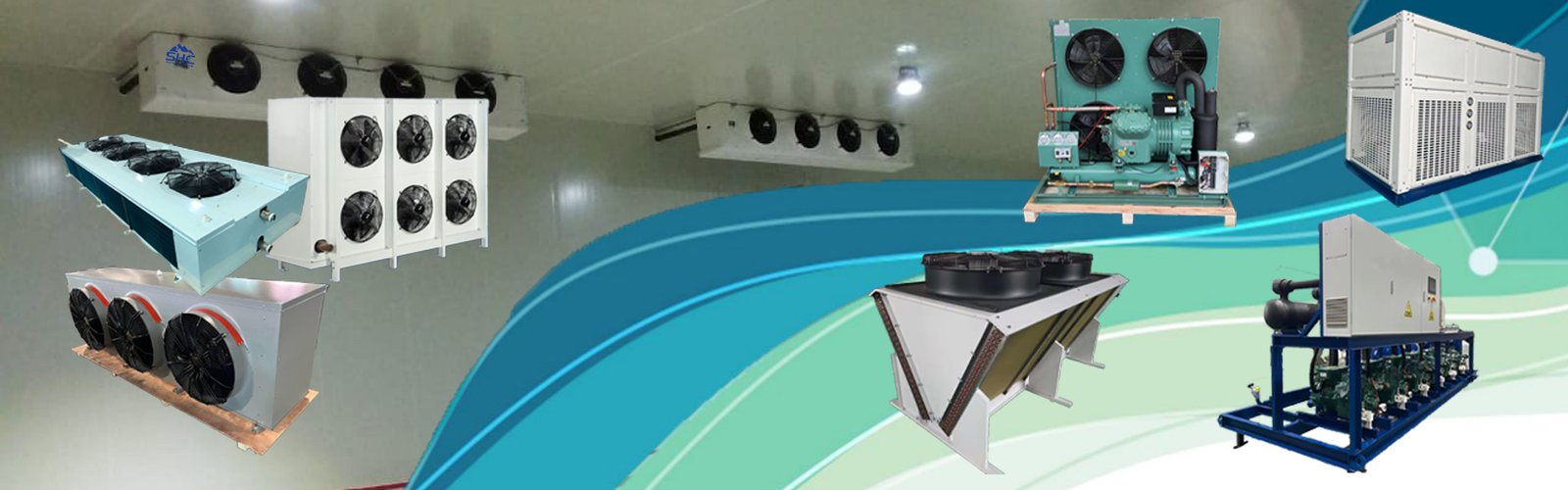
A Cold Room Condensing Unit is a specific, pre-assembled package. It’s essentially the powerhouse of the refrigeration cycle, typically housed in a single weatherproof casing. You’ll find the compressor, the condenser coil, the condenser fan(s), and necessary electrical controls all in one box. It’s designed to be mounted outside the cold room (or on a rooftop), connected to an evaporator unit (the part with the fan that blows cold air) located inside the insulated space via refrigerant piping. It’s a dedicated “one-to-one” or sometimes “one-to-few” solution for a specific enclosed space.
A Commercial Refrigeration System is a broader, more complex term. It refers to the complete, integrated setup required to achieve and maintain a controlled low-temperature environment. This includes the condensing unit (which could be a single unit, a parallel compressor rack, or a screw compressor pack), but also encompasses:
- The evaporators (cooling units) inside the cooled space.
- The precise refrigeration piping network.
- Sophisticated control panels, sensors, and monitoring systems.
- Often, secondary systems like pump packs for glycol circulation, complex defrost management, and integrated energy management software.
In short, the condensing unit is a critical component you purchase. The commercial refrigeration system is the complete, engineered application you design and install.
H2: Where Each One Shines: Industry-Specific Applications
This is where your client’s business dictates the path.
When a Cold Room Condensing Unit is the Go-To Choice:
- Standalone Cold Storage & Warehousing: A logistics company needs to add a 500m³ freezer (-25°C) for storing frozen seafood. A robust, low-temperature condensing unit paired with a matching evaporator is a perfect, turnkey solution.
- Hospital & Laboratory Pharma Stores: A clinic requires a +2°C to +8°C room for vaccines. Redundancy is key. Often, two condensing units in a lead/lag configuration provide the needed backup without the complexity of a massive central system.
- Hospitality & Restaurant Kitchens: A hotel needs a new walk-in chiller for produce and a walk-in freezer for bulk meat. Individual condensing units for each room offer flexibility, easier zoning, and simpler maintenance.
- Floral Distributors: A flower wholesaler needs a +1°C high-humidity cold room. A specialized condensing unit designed for medium-temperature, high-load applications fits the bill perfectly.
- Retail Backrooms: Supermarkets use them for back-of-house storage freezers and chillers, especially for smaller or satellite stores.
When a Full Commercial Refrigeration System is Non-Negotiable:
- Large-Scale Food Processing Plants: A poultry processing facility with blast freezing tunnels, spiral freezers, processing rooms, and large storage freezers. This requires a centralized compressor rack system with multiple circuits, sophisticated controls for different temperature zones, and heat reclaim capabilities.
- Hypermarkets & Supermarket Chains: An entire store with dozens of open display cases, walk-ins, and preparation rooms. A distributed commercial system, often with parallel compressor racks located in a machine room, serving multiple circuits via a liquid overfeed or direct expansion (DX) pipe network, is the only efficient answer.
- Beverage & Brewery Cooling: Large breweries need precise glycol chilling systems for fermentation control. This involves chillers (a type of condensing unit for cooling secondary coolant), extensive piping, and PLC-controlled automation.
- Climate-Controlled Logistics Hubs: Massive distribution centers with multi-temperature zones (ambient, chilled, frozen) under one roof require a built-from-scratch commercial refrigeration system, often integrating with the building’s HVAC.
H2: The Dealer’s Decision Matrix: Cost, Control, and Complexity
As a dealer, you need to weigh these factors for every project. Here’s a real-time comparison based on current (2023-2024) market and technical trends:
| Feature/Aspect | Cold Room Condensing Unit | Commercial Refrigeration System |
|---|---|---|
| Initial Investment | Lower upfront cost. Predictable pricing for the unit. | Significantly higher. Includes design, multiple components, complex installation. |
| Installation & Lead Time | Faster, simpler. Often a “plug-and-play” setup for skilled technicians. | Lengthy. Requires detailed engineering, multiple trades, and extensive commissioning. |
| Scalability & Flexibility | Limited. Adding capacity often means adding another separate unit. | High. Centralized racks can often add compressor modules. Systems are designed for future expansion. |
| Energy Efficiency | Good for single applications. Variable Speed Drive (VSD) options are now standard on mid-to-high-end models. | Potentially superior at scale. Systems can use advanced strategies like heat recovery, floating condensing pressure, and optimal compressor sequencing. |
| Control & Monitoring | Basic. Unit-level controls and alarms. Can integrate with simple BMS. | Comprehensive. Centralized PLC/SCADA systems allow for detailed monitoring, data logging, predictive maintenance, and remote management. |
| Maintenance & Service | Simpler. Isolated faults, easier diagnosis, and component swap. | More complex but organized. Centralized machine room allows for proactive maintenance but requires highly specialized technicians. |
| Footprint | Distributed. Units are placed near their cold room, which can use up exterior wall or roof space. | Consolidated. Central machine room frees up retail/warehouse space but requires dedicated plant room area. |
| Best For | Specific, defined cold rooms; modular expansion; projects with budget constraints; simpler operational needs. | Large-scale, multi-temperature facilities; projects where long-term TCO and control are priorities; complex cooling processes. |
H2: The Tech Specs That Matter: Reading Between the Lines
Talking specs with manufacturers is key. Don’t just look at cooling capacity (kW) at a single set point.
For Condensing Units: Demand full performance data across a range of evaporating and condensing temperatures. Ask about the Application Range. A unit that performs efficiently at both -35°C evaporating (for low temp) and +5°C evaporating (for medium temp) offers more flexibility. VSD integration is now a must-consider for part-load efficiency. Check the standard control features—do they offer electronic expansion valve (EEV) compatibility, alarm relays, and communication protocols (like Modbus)?
- For System Components: When sourcing parts for a built-up system, compatibility is king. Compressor types (piston, scroll, screw) are selected based on load profile. Condenser approach temperatures and Evaporator TD (Temperature Difference) directly impact efficiency and humidity control—critical for fresh produce. Insist on AHRI certification or equivalent performance ratings for matched components to ensure claimed efficiency.
H2: Future-Proofing Your Client’s Investment: The Sustainability & Regulatory Angle
Global trends are pushing regulations. The F-Gas regulation in the EU and similar shifts worldwide are phasing down high-GWP refrigerants like R404A and R507A.
- The Refrigerant Shift: For condensing units, the market is rapidly moving toward lower-GWP options like R448A/R449A (for retrofit and new), R455A (ultra-low GWP, mildly flammable A2L), and natural refrigerants like CO2 (R744) in booster systems for low temp. As a dealer, stocking units charged with future-proof refrigerants is a strategic move.
- Efficiency Mandates: MEPS (Minimum Energy Performance Standards) are getting stricter globally. Offering units and systems that exceed these standards, featuring VSDs, EC fans, and high-efficiency heat exchangers, is no longer a premium option but a necessity for many tenders.
- The Data Advantage: Modern commercial systems offer connectivity. Being able to provide your client with a system that delivers real-time energy consumption data, predictive fault alerts, and remote adjustment capability adds immense service value and locks in long-term maintenance contracts.
Professional Q&A Section
Q1: My client has a growing business. They start with one cold room now but plan to add three more in the next two years. Should I recommend individual condensing units or plan for a centralized system from day one?
A: This is a classic scalability question. While individual units offer lower initial cost, a modular, pre-planned centralized system (like a compact parallel rack designed for future compressor addition) can be more cost-effective and efficient in the long run. The deciding factors are: 1) The proximity of the future cold rooms (are they adjacent?), 2) The total projected load, and 3) Available space for a plant room. Often, a hybrid approach works: install a slightly oversized condensing unit with spare circuit capacity on the first room, allowing it to serve a second evaporator in a future room with minimal added cost.
Q2: Are “natural refrigerant” systems like CO2 (R744) only for large commercial systems, or are they available for standard cold rooms?
A: This is a rapidly evolving area. While CO2 systems are famous for large supermarkets, the technology has trickled down. Yes, there are now pre-packaged, transcritical CO2 condensing units available for individual cold rooms, especially in Europe and other regions with strong environmental regulations. They are particularly advantageous for low-temperature applications (freezers) where CO2’s efficiency shines, and they future-proof the installation against refrigerant phase-outs. However, they typically have a higher initial cost and require technicians with specific training.
Q3: How significant are the energy savings with VSD (Variable Speed Drive) on a condensing unit, and is the premium cost justified?
A: The savings are very significant, often between 20-40% compared to fixed-speed units, depending on the load profile. Cold rooms rarely run at 100% load continuously. A VSD allows the compressor to precisely match its speed (and thus power draw) to the exact cooling demand, avoiding the stop-start cycles of fixed-speed units. The payback period for the VSD premium can be as short as 1-2 years in applications with high runtime and variable loads (like chillers with frequent door openings). For most new installations, specifying VSD is becoming the standard recommendation.
Q4: When sourcing from a manufacturer, what are the key certifications or test reports I should ask for to verify quality and performance claims?
A: Always request:
- Performance Certification: AHRI (Air-Conditioning, Heating, and Refrigeration Institute) or EUROVENT certification for matched components (condensing unit + evaporator). This independently verifies cooling capacity and efficiency ratings.
- Electrical Safety Certification: CE, UL, or equivalent for the target market, ensuring electrical safety standards are met.
- Pressure Equipment Directive (PED) / ASME Compliance: For the vessel components, ensuring structural integrity.
- IP (Ingress Protection) Rating: For outdoor units, an IP rating (e.g., IP54 or higher) confirms protection against dust and water.
- Third-party test reports from accredited labs for specific claims like low ambient operation or noise levels. A reputable manufacturer will have these documents readily available.