
You are in the business of moving cooling units across borders. Your customers—hotel chains in Dubai, restaurant groups in Bangkok, server farm operators in Lagos, or factory owners in Mexico—all need one thing: a cooling unit that actually does its job without costing a fortune in electricity or causing endless service calls. The problem is, the market is flooded with options. Window units, portable units, mini-splits, ceiling cassettes, and industrial spot coolers. Each one has a different capacity rating, different refrigerant, different voltage, and different target use case.

If you are sourcing for B2B buyers, you cannot just look at the price tag. You need to know which unit fits which room type, which climate zone, and which installation scenario. This guide is built for you—the exporter, the importer, the distributor who needs to make smart stock decisions. No fluff, no metaphors, just real numbers and real situations.
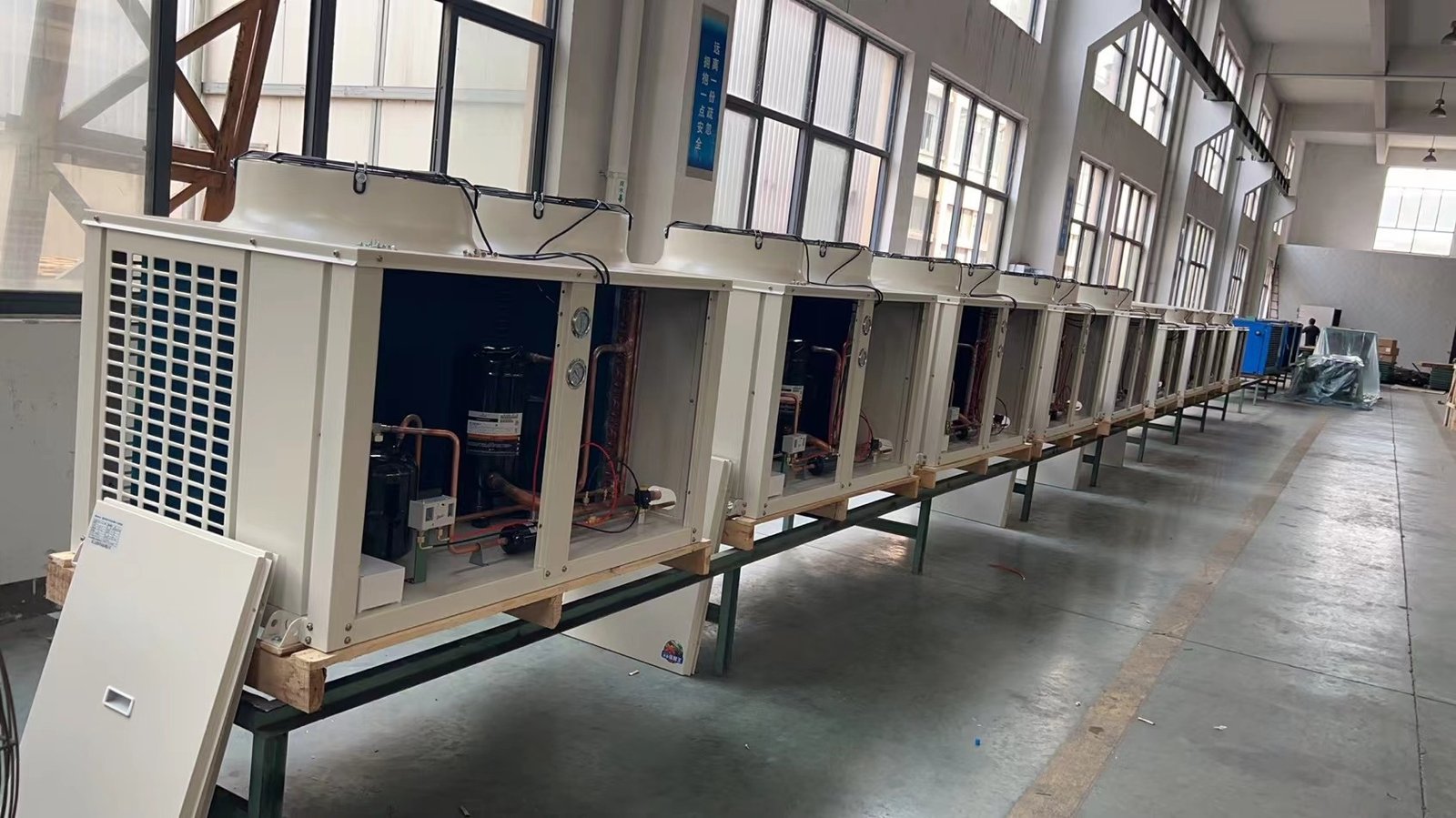
Let’s get straight into it.

Room Size and Heat Load: The Two Numbers That Never Lie
The first thing you need to understand is that a cooling unit’s capacity is measured in British Thermal Units per hour (BTU/h). But BTU ratings are only half the story. A 12,000 BTU unit might cool a 500-square-foot room perfectly in New York, but fail miserably in a similar-sized room in Riyadh. Why? Because heat load depends on more than square footage.
Heat load factors include:
- Ceiling height
- Number of windows and their orientation (south-facing windows get more sun)
- Insulation quality
- Number of people normally in the room
- Heat-generating equipment (computers, ovens, machinery, lights)
- Local outdoor temperature and humidity
A quick rule of thumb that most HVAC engineers use: for a standard room with 8-foot ceilings, moderate insulation, and typical occupancy, you need about 20 BTU per square foot. So a 300 sq ft room needs 6,000 BTU. But if that room has large windows facing west, add 10%. If it’s a commercial kitchen, multiply by 2.5 because of cooking heat. If it’s a server room with high-density servers, you might need 30 to 40 BTU per square foot.
As a distributor, you should always ask your end customer for these details before recommending a model. To help you visualize, here is a quick reference table based on real-world conditions for typical commercial rooms:
| Room Type | Typical Area (sq ft) | Recommended BTU Range | Notes |
|---|---|---|---|
| Small office (1-2 people, no equipment) | 150-200 | 5,000 – 7,000 | Standard insulation |
| Medium conference room (4-6 people, projector) | 250-350 | 8,000 – 12,000 | Include heat from people and projector |
| Restaurant kitchen (cooking equipment, 80°F ambient) | 200-300 | 18,000 – 24,000 | High heat load; need commercial-grade unit |
| Server room (10-15 racks, 5 kW heat dissipation) | 100-150 | 12,000 – 18,000 | Continuous operation; need precision cooling |
| Retail store (open front, many LED lights) | 400-600 | 14,000 – 24,000 | Consider door openings and foot traffic |
| Hotel guest room (standard double bed, bathroom) | 250-350 | 9,000 – 12,000 | Split-type or PTAC (packaged terminal air conditioner) |
| Industrial small workshop (machinery, 1-2 workers) | 500-800 | 24,000 – 36,000 | Often needs spot cooling or high-wall units |
This table is a starting point. For your B2B buyers, you should also provide a heat load calculation sheet or an online tool. That builds trust and reduces return rates.
Types of Cooling Units: Which One Moves in Your Market?
Not all rooms are the same, and not all countries prefer the same type of unit. From an export perspective, you need to know what sells where. Here is the breakdown.
Window Units
These are still the kings in price-sensitive markets like Southeast Asia, parts of Latin America, and the Middle East for light commercial use. They are cheap to manufacture, easy to install (just cut a hole or fit in a window frame), and require only a standard power outlet. But they have downsides: noise, limited cooling capacity (usually up to 25,000 BTU), and they block part of the window.
For B2B customers in hot climates, window units are often used in individual rooms in budget hotels, dormitories, and small shops. However, do not expect them to be energy efficient. Most window units have an Energy Efficiency Ratio (EER) between 8 and 12. Newer models with inverter compressors can hit 14 EER, but they cost more.
Portable Units
Portable air conditioners are popular in places where window installation is not allowed or practical, such as rented apartments, historical buildings, or offices with no AC ductwork. They come with a hose that vents hot air out through a window or wall. But here is a hard truth: portable units are generally 30% less efficient than window units of the same BTU. That is because the unit sits inside the room and pulls some of the cooled air to cool the condenser, creating negative pressure. Plus, the hose radiates heat back into the room.
For exporters, portable units sell well in Europe and North America, where renters are a huge market. But warn your dealers about the efficiency penalty. If a customer needs 12,000 BTU of actual cooling, they should buy a unit rated at 15,000 or 16,000 BTU.
Split Systems (Mini-Split and Multi-Split)
This is the most common choice for commercial and residential spaces in most of Asia, the Middle East, and increasingly in North America for retrofits. A split system has two parts: an indoor unit (wall-mounted, ceiling cassette, or floor-standing) and an outdoor condenser. The main advantages: quiet operation, high efficiency (SEER 16 to 30 is common), and flexible placement.
For B2B buyers, mini-splits are ideal for individual rooms in hotels, small offices, and apartments. Multi-split systems (one outdoor unit connected to multiple indoor units) are great for larger buildings where you want zone control.
A key consideration for importers: most mini-splits use R32 refrigerant (as of 2024-2025, phasing out R410A in many countries). R32 is more efficient and has lower global warming potential, but it is mildly flammable (A2L classification). Make sure your units meet local safety standards—especially in commercial kitchens or near flammable materials.
Packaged Terminal Air Conditioners (PTAC)
You see PTACs in hotel rooms, motels, and some commercial apartments. They are basically through-the-wall units, similar to window units but designed for permanent installation. They sit in a sleeve cut into the wall and have the condenser exposed outside. PTACs are common in North America and parts of Europe because they allow individual room control and are easy to replace.
If you supply PTACs to hotel chains, you need to check voltage (usually 208/230V in the US), heating options (electric heat strip or heat pump), and noise levels (hotel guests hate loud units). Newer PTACs with inverter compressors can achieve EER up to 12.5, which is decent.
Industrial Spot Coolers
These are heavy-duty units designed for specific areas like manufacturing floors, warehouses, or data center hot spots. They are usually portable (on wheels) and have high BTU ratings (24,000 to 60,000 BTU). They discharge cool air through a flexible duct and exhaust hot air through another duct that goes outside.
Spot coolers are not meant to cool an entire room. They target a specific area or machine. For example, a steel factory might use a spot cooler to keep workers comfortable near a furnace, or a telecom company might use one to cool a row of servers in a temporary setup.
As an exporter, spot coolers have a niche market: industrial distributors, event companies, and emergency cooling rental businesses. They are expensive but have good margins.
Climate and Voltage: The Hidden Deal Breakers
You can send the same cooling unit to two different markets and get completely different results. Climate is a major factor. A unit designed for a dry desert climate (like Saudi Arabia) might struggle in a humid tropical climate (like Indonesia). This is because the cooling capacity drops when the outdoor temperature is very high. Most units are rated at 95°F (35°C) outdoor temperature. If your customer is in a place where summer temperatures hit 120°F (49°C), the actual cooling output can drop by 20-30%.
Same for humidity. In high humidity, the unit must work harder to remove moisture, which reduces sensible cooling. Some markets in Southeast Asia need units with higher latent cooling capacity (moisture removal). If your unit is optimized for dry heat, your customers will complain about moldy rooms.
Voltage is another massive issue. China, for example, uses 220V/50Hz. North America uses 120V/208V/60Hz. Japan uses 100V/50Hz or 60Hz depending on region. Middle East uses 230V/50Hz. If your cooling unit has a compressor that runs on 50Hz but you ship it to a country with 60Hz, the motor will spin faster, potentially damaging the compressor. You must stock or offer different voltage and frequency versions. Put voltage labels clearly on the packaging—do not assume the importer knows.
Here is a quick reality check table for voltage and frequency by major import markets:
| Market | Common Voltage (V) | Frequency (Hz) | Plug Type | Notes |
|---|---|---|---|---|
| United States | 115/208/230 | 60 | NEMA 5-15 (115V), NEMA 6-15 (208/230V) | Large units need 208-230V |
| Canada | 120/208/240 | 60 | Similar to US | Same plug types |
| United Kingdom | 230 | 50 | BS 1363 (3-pin) | Need UK plug or adapter |
| Germany / EU | 230 | 50 | Schuko (CEE 7/4) | Common across continental EU |
| Australia / New Zealand | 230 | 50 | AS/NZS 3112 | Two angled pins |
| Japan | 100 | 50 (east) / 60 (west) | Type A or B | Two different frequencies; check region |
| Saudi Arabia / Gulf | 230 | 50 / 60 (mixed) | BS 1363 or Schuko | 60Hz in parts of UAE, 50Hz in KSA |
| India | 230 | 50 | Type D or M | High voltage fluctuations common |
If you are exporting to multiple markets, consider using universal compressors that can handle 50/60 Hz, or specify the exact Hz on the order. This is where you can lose or win a bid.
Energy Efficiency and Certifications: The Sales Tools That Matter
Your B2B buyers are not just buying a box. They are buying a product that needs to meet local regulations. In many countries, energy efficiency standards are getting stricter. For example:
- In the United States, the Department of Energy (DOE) sets minimum SEER2 standards for split systems (15 SEER2 as of 2023 for many regions). Window units must meet a combined energy efficiency ratio (CEER) standard. As of 2024, new rules require some window units to have CEER of at least 11.0.
- In Europe, the Energy Labelling Directive requires A+ to D labels. Units below a certain threshold cannot be sold. The upcoming 2025 regulations will phase out R410A and move to R32 or R290 (propane).
- In China, the new GB standard (GB 21455-2019) sets minimum Energy Efficiency Index (EER/APF) for different types. Many Chinese manufacturers already produce high-EER units that meet export standards.
- In India, the Bureau of Energy Efficiency (BEE) awards 1 to 5 stars. 5-star units are the most efficient and command premium prices.
As an exporter, you should always have your units tested by an approved lab and obtain the relevant certificates. Common ones include:
- CE – for European market (mandatory)
- UL or ETL – for North America (UL is widely recognized)
- SASO – for Saudi Arabia
- GSO – for Gulf countries
- SAA – for Australia
- NOM – for Mexico
- EAC – for Eurasian Economic Union (Russia, Kazakhstan, etc.)
Do not skip certifications. You might find a buyer who says “just send it, we’ll deal with customs”, but that leads to seized shipments and fines. Real B2B importers want the paperwork.
Another important point: refrigerant type. The global phase-down under the Kigali Amendment to the Montreal Protocol is real. R22 is banned in most countries. R410A is being phased out (new installations banned in EU from 2025). R32 is now the common choice for new split units. R290 (propane) is used in some portable and small window units. R290 is highly flammable, but it has very low Global Warming Potential (GWP of 3). If you export to Europe, you will see more R290 units. However, some countries have restrictions on flammable refrigerants in commercial spaces. Check local codes.
Installation and Service: What Your Dealers Need to Know
A cooling unit is not a plug-and-play toaster. Installation mistakes cause the most complaints. Here are the top things your B2B customers should pass on to their end users:
- Clearance for airflow: The outdoor unit (split system, PTAC) needs at least 2 feet of space around the condenser fins. Too close to a wall, and the unit will recirculate hot air, causing overheating and compressor failure.
- Drainage: Condensate water must drain away properly. In high humidity, a portable unit’s water container can fill up in hours. Many units have a continuous drain option. Make sure the instructions include how to connect a hose.
- Electrical circuit: Don’t plug a 24,000 BTU unit into a standard 15A outlet. It will trip the breaker. Install a dedicated circuit with the correct wire gauge.
- Refrigerant charge: Pre-charged units come with a certain amount of refrigerant. If the line set is longer than the standard (usually 16 feet), you need to add refrigerant. That requires a technician. Your importers should stock additional refrigerant for repairs.
- Filter cleaning: Dirty filters reduce efficiency. In dusty regions like the Middle East or North Africa, filters need cleaning every two weeks. Recommend washable filters and include a reminder card.
As a manufacturer, you can differentiate by providing clear, visual installation manuals in multiple languages (English, Arabic, Spanish, French, etc.). Many Chinese manufacturers skimp on this and get complaints. Invest in good manuals—it reduces support calls.
Specialized Industries: Where the Niche Markets Are
You asked for industries. Here are three specific examples where cooling unit requirements differ significantly from a standard room.
Data Centers
Data centers need precise temperature and humidity control, 24/7/365. Standard window or split units cannot handle the constant load and tight tolerances (±1°C). You need server-room-specific units (also called precision cooling or computer room air conditioners). These units have features like:
- Redundant compressors (dual circuit)
- Hot gas bypass for dehumidification without overcooling
- High static pressure for ducting to underfloor plenums
- Remote monitoring via Modbus or SNMP
- Outdoor units with corrosion protection (since data centers are often in urban areas with pollution)
If your factory makes these, you sell to IT integrators and telecom companies. Price per unit is high, but volume is lower.
Restaurants and Commercial Kitchens
Restaurants have heat from stoves, fryers, ovens, and dishwashers. The ambient temperature can be 100-120°F. Regular split units will fail quickly because the condenser gets too hot. You need commercial-grade units with:
- Outdoor units rated for high ambient (up to 125°F or 52°C)
- Compressors with high temperature tolerance (scroll compressors are better than reciprocating)
- Grease-proof filters (or install the indoor unit away from the cooking area)
- Easy-to-clean surfaces
Many restaurant owners use mini-splits but place the indoor unit in the dining area, not the kitchen. For the kitchen itself, they use spot coolers or exhaust hoods. As a supplier, you can offer a package: a high-ambient split for the dining room and a spot cooler for the kitchen.
Healthcare Facilities
Hospitals and clinics need cooling that maintains positive pressure, filtration (HEPA or MERV-13), and quiet operation (patient rooms). Window units are usually not allowed because of noise and air leakage. Split systems with ducted or cassette units are common. But the real requirement is infection control: the unit must not accumulate mold inside. That means:
- Drain pans that tilt to prevent standing water
- Anti-bacterial coating on fins
- UV-C lights in the indoor unit (optional but becoming standard in premium models)
If you target this sector, you need certifications like ISO 13485 (medical device quality) or at least hospital-grade material list.
Pricing and Logistics: What Effective Distributors Care About
Let’s talk money and shipping. As a B2B exporter, your price is often quoted FOB (Free on Board) or CIF (Cost, Insurance, Freight). The cooling unit’s size and weight affect freight costs significantly. A 12,000 BTU mini-split weighs about 50-60 kg (indoor + outdoor unit + accessories). A 40-foot container can hold roughly 150-200 sets. That is your unit cost calculation.
But there are extra costs:
- Packaging: Units must survive ocean shipping. Double-wall corrugated boxes, foam inserts, and wooden pallets. Some buyers require export-worthy packaging without staples (to avoid damage to units).
- Warranty: Most Chinese manufacturers offer 1-year warranty on parts, but 3-5 years on the compressor. Your importer may want a local warehouse for spare parts. If not, you need to ship replacement parts quickly.
- MOQ (Minimum Order Quantity): For customized units (custom voltage, color, brand logo), the MOQ is typically 100-200 units per model. For standard units, MOQ can be as low as 50 units.
- Payment terms: L/C at sight is common for first-time buyers; T/T (30% advance, 70% after shipping) is standard for repeat customers.
One real-world example: A distributor in South Africa wanted 500 portable units (12,000 BTU) for the summer season. They required labeling in English and Afrikaans, plus a spare condenser fan motor per 10 units. They also wanted the units to have a 220V/50Hz South African plug (Type M). If your factory can do that customization quickly, you win the order. Otherwise, they go to a competitor.
Certifications and Standards Quick Guide
Here is a table of key certifications by region that your units should have to enter the market easily:
| Region | Required Certification | Issuing Body | Notes |
|---|---|---|---|
| EU | CE (mandatory), ErP (energy label) | Notified body / self-declaration | Also need WEEE and RoHS |
| USA | UL / ETL (safety), DOE (energy), Energy Star (optional) | UL, Intertek, DOE | Window units need CEER rating |
| Canada | CSA (safety), NRCan (energy) | CSA Group | Similar to US but separate |
| Saudi Arabia | SASO 2663 (energy), SASO 2899 (safety) | SASO / SABER | Also need IECCB certificate |
| UAE | ESMA (safety, energy) | ESMA | Often accepts SASO or GSO |
| Australia | RCM (safety + EMC), MEPS (energy) | ACMA, Australian regulators | GEMS label required |
| Mexico | NOM-001, NOM-003, NOM-016 | Secretaría de Energía | Energy label by SENER |
| India | BEE star rating (mandatory for some types), ISI (optional) | BEE, BIS | Large range due to voltage fluctuations |
| Brazil | INMETRO, ANEEL | INMETRO | Portaria 269/2019 for ACs |
| Russia / EAEU | EAC (Eurasian Conformity) | EAC | Required for all five countries |
| Japan | PSE (Electrical Appliance and Material Safety Law) | METI | Very strict on 100V rating |
If you are a manufacturer, having a single multi-standard R32 unit that can meet CE, UL, and SASO is a big advantage. Some factories produce a “global model” with a voltage range (220-240V, 50/60Hz) and multiple plug options included in the box. That reduces SKU complexity for importers.
The Hidden Costs You Must Tell Your Buyers About
A cooling unit’s purchase price is just the beginning. Your B2B customers need to factor in installation, electricity, and maintenance over the unit’s life. For example, a cheap window unit at $200 might have an EER of 8. Over 5 years of daily use in a hot climate, it will cost about $800 more in electricity than a $400 unit with EER of 12. That is a big difference.
Use this simple calculation:
- Unit A: 12,000 BTU, EER 8 → power consumption = 12,000 ÷ 8 = 1,500 watts
- Unit B: 12,000 BTU, EER 12 → power consumption = 1,000 watts
- Difference: 500 watts per hour
- If the unit runs 8 hours/day, 200 days/year = 1,600 hours per year
- Electricity cost $0.12 per kWh → $0.12 × 0.5 kW × 1,600 hours = $96 per year
- Over 5 years = $480
So the higher-efficiency unit saves $480 in electricity, even though it costs more upfront. Share this with your dealers so they can sell better.
Another hidden cost: maintenance. In dusty environments, condenser coils get blocked. If a customer doesn’t clean them, the unit’s capacity drops and the compressor works harder, eventually failing. A unit that costs $300 to replace but requires $100 in service calls every 2 years? That is a bad deal. Recommend units with easy-to-clean coils (like ones with removable grilles).
5 Real-World Questions Your B2B Clients Ask (And How to Answer)
Q1: I want to import split-type air conditioners for a hotel project in Dubai. What specific features should I look for?
You need units with high ambient temperature tolerance (up to 52°C outdoor), corrosion-resistant condenser coils (salt air from the coast), and a built-in surge protector (voltage fluctuations common). Best to choose R32 refrigerant for better efficiency in hot weather. Also, make sure the indoor unit has a Turkish or Arabic language option for the remote control. Some hotels want quiet operation below 35 dB(A) for guest rooms.
Q2: Our customers keep complaining that portable air conditioners are too loud and don’t cool. What should we change?
First, educate your customers on the efficiency penalty (see earlier). Second, look for portable units with a dual-hose design (one intake, one exhaust) instead of single hose. A single-hose unit pulls air from the room to cool the condenser, creating negative pressure that draws hot air in from outside. Dual-hose units use outside air for condenser cooling, which improves efficiency by 20-30% and reduces noise because the compressor doesn’t have to run as long. Also, recommend units with a higher BTU rating than the room requires (e.g., 14,000 BTU for a 300 sq ft room). And always advise them to seal the window gap properly with the included panel.
Q3: We are buying window units for a chain of convenience stores in Nigeria. The electricity is unreliable. Any advice?
You need units that can handle voltage fluctuations (from 180V to 260V). Look for units with a wide voltage range and a good quality start capacitor. Also, consider units with an auto-restart feature—after a power cut, the unit should resume operation automatically. Avoid units with digital boards that are sensitive to brownouts. Some manufacturers offer “heavy duty” or “industrial” window units designed for unstable grids. Check if they have thermal overload protectors.
Q4: What is the most cost-effective way to ship cooling units from China to Europe? Air or sea?
Sea freight is always cheaper for heavy items like AC units. A 20-foot container holds about 60-80 split sets (depending on packaging). Cost to Rotterdam from a Chinese port is roughly $1,500 to $3,000 per container (2024 rates, subject to change). Air freight is only used for urgent orders or small samples. But note: sea shipments take 30-45 days, so you need to order in advance of the summer season. Also, insurance against damage is essential because of container handling.
Q5: We are new to importing. How do we verify a Chinese manufacturer’s quality without flying there?
You can hire a third-party inspection company like SGS, Bureau Veritas, or TÜV Rheinland to perform a factory audit and product testing. They can check production capacity, quality control processes, and batch sampling. Many manufacturers have a minimum order quantity; ask for a pre-production sample first. Also, request a copy of their ISO 9001 certificate and UL/CE test reports. If they refuse, walk away. Another option: attend a trade show like Canton Fair, where you can see multiple suppliers and compare quality hands-on.
That is the real-world guide. No metaphors, no padding. If you want to succeed in the cooling unit export business, focus on matching the unit to the room’s actual heat load, respecting local voltage and certification rules, and being honest about efficiency trade-offs. Your customers will thank you with repeat orders.