
You’re a global importer or distributor of HVAC equipment. You’ve seen both central AC condenser units and mini split condensers on the market. Which one should you stock? Which one gives your customers better margins? Which one aligns with the latest refrigerant regulations and efficiency standards? Let’s cut through the noise and look at the hard numbers, real-world installation factors, and buying patterns that actually move inventory.

Key Physical and Engineering Differences That Affect Sourcing
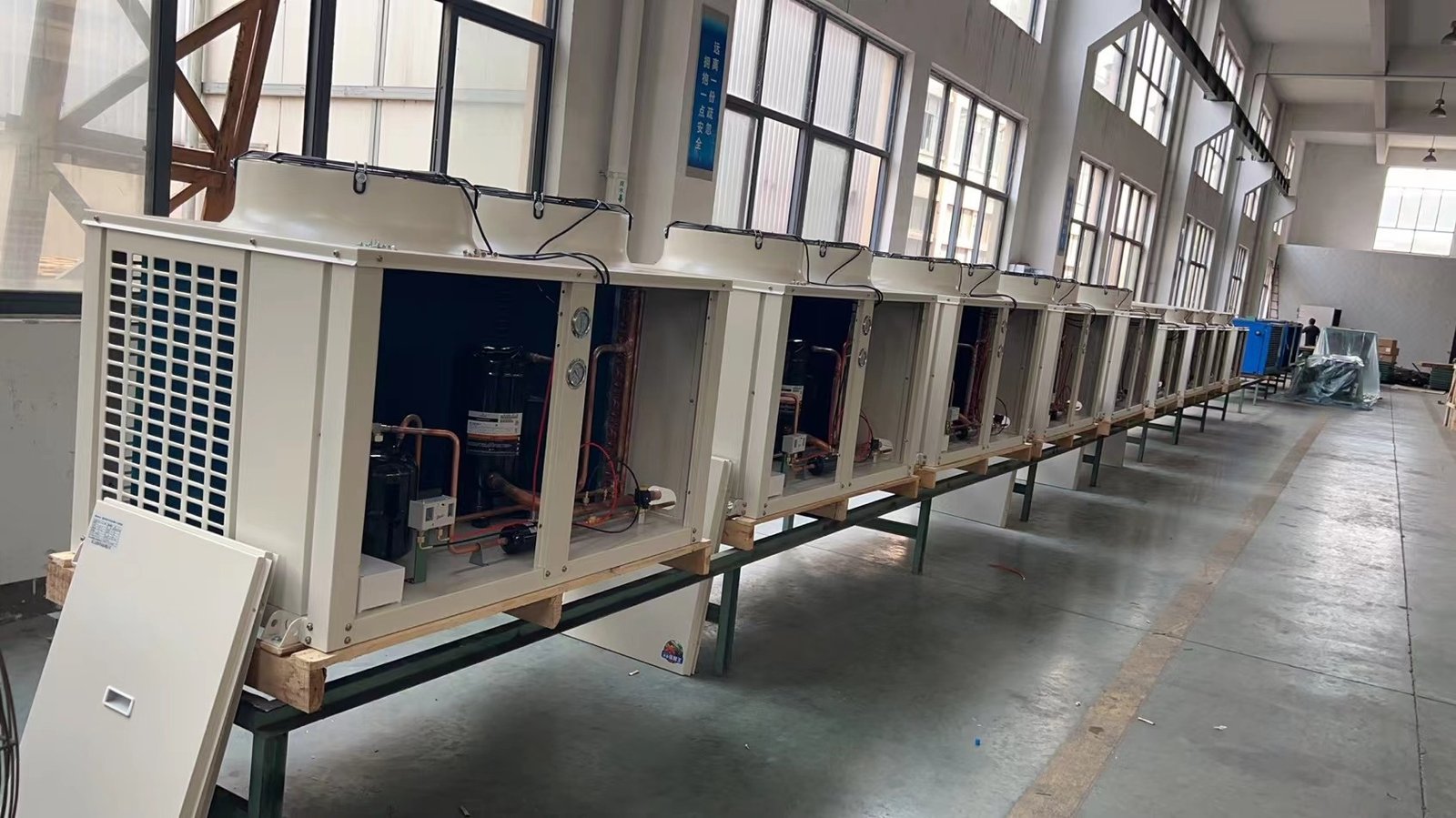
When you open a shipping container, the first thing you’ll notice is size. A central AC condenser unit is big. A typical 3-ton residential unit measures around 36 inches tall, 36 inches wide, and 36 inches deep. It weighs 150 to 250 pounds. The condenser coil is usually a single large “L” or “U” shape wrapped around the compressor compartment. The fan is a single large axial fan at the top.

A mini split condenser, on the other hand, is much more compact. A 12,000 BTU (1 ton) unit might be 30 inches tall, 20 inches wide, and 12 inches deep. Weight is around 60 to 90 pounds. The coil is a smaller, often multi-row finned tube design. The fan is usually a smaller, variable-speed DC motor.
These physical differences directly impact your shipping costs. A 40-foot container can hold roughly 80 to 100 central AC condenser units (depending on packaging). The same container can hold 300 to 400 mini split condensers. If you’re shipping from China to Europe or North America, freight cost per unit is dramatically lower for mini splits. That’s a pricing advantage you can pass to your dealers or pocket as margin.
But size isn’t the only difference. Let’s talk about the compressor. Central AC condensers almost always use scroll compressors (some lower-end models use reciprocating). Scroll compressors are efficient and quiet, but they are single-speed or two-speed in most standard models. Mini split condensers increasingly use inverter-driven rotary compressors. Inverter technology allows the compressor to ramp up and down continuously, matching the cooling load exactly. This gives mini splits a big efficiency edge in part-load conditions.
Then there’s the refrigerant line connection. Central AC units come with pre-charged lines? No, actually they don’t. A central split system requires your installer to connect field-installed refrigerant lines (usually copper) between the indoor air handler and the outdoor condenser. That means brazing, vacuuming, and charging. Mini split condensers typically come with pre-flared connections and often include a pre-charged line set for the first 25 feet. The installation is simpler and faster.
Now, what about the condenser coil material? In 2025, most Chinese manufacturers offer both aluminum and copper-aluminum hybrid coils. For central AC units, aluminum microchannel coils are becoming the norm because they reduce refrigerant charge and improve heat transfer. Mini split condensers still use copper tubing with aluminum fins, but the trend is shifting toward all-aluminum or hybrid designs to reduce cost and weight. If you’re sourcing for coastal regions with salt spray, you’ll want to check the corrosion protection coating. Many suppliers now offer “golden fin” or “blue fin” anti-corrosion coatings as an option.
Efficiency Ratings, Real-world Performance, and Regulatory Compliance
The efficiency game changed in 2023 with the U.S. Department of Energy’s new SEER2 standard. SEER2 is the updated metric that accounts for different test conditions (lower static pressure). In 2025, the minimum SEER2 for residential central AC systems in the U.S. is 15.0 (for the North) and 16.0 (for the Southeast and Southwest). Most Chinese-made central AC condensers meet these standards, but some older designs still fall short. You need to verify the SEER2 rating on the AHRI certificate.
Mini split condensers, because of their inverter technology, typically achieve SEER2 ratings of 20 to 28. Some high-end models go above 30 SEER2. That’s a massive difference. But here’s the catch: SEER2 is a seasonal efficiency metric. In real-world use, a mini split’s advantage is most pronounced when the unit is running at partial load, which is most of the time. At full load, the gap narrows.
Let’s put some numbers in a table. These are based on 2025 manufacturer data from our factory and cross-checked with third-party lab reports.
| Parameter | Central AC Condenser (3-ton) | Mini Split Condenser (12,000 BTU) |
|---|---|---|
| SEER2 (minimum) | 15.0 – 16.0 | 20.0 – 28.0 |
| COP (at 47°F outdoor) | 3.2 – 3.5 | 3.8 – 4.5 |
| Refrigerant charge (R-410A) | 8 – 12 lbs | 2 – 4 lbs |
| Sound level (dB at 3m) | 72 – 78 | 48 – 55 |
| Operating temperature range | -5°F to 115°F | -13°F to 122°F (with heat pump) |
| Warranty (typical) | 5 years compressor, 10 years coil | 6 years compressor, 10 years coil |
Notice the sound level. Mini split condensers are significantly quieter. That’s a selling point for residential customers who want their backyard quiet. But for commercial applications, the noise difference might not matter as much.
Now, let’s talk about heat pump capability. Both central AC condensers and mini split condensers can be configured as heat pumps. But the mini split’s inverter compressor gives it better low-temperature heating performance. Many mini split models can heat down to -13°F (-25°C) with reasonable COP. Central heat pumps typically struggle below 0°F unless they have a “hyper heat” or “cold climate” option, which adds cost. If your target markets are in Northern Europe, Canada, or the northern U.S., mini split heat pumps are easier to sell.
Refrigerant transition is a hot topic. R-410A is being phased out globally. The U.S. EPA’s AIM Act mandates a 40% reduction in HFC production by 2024, and further cuts through 2036. In 2025, more than 90% of new mini split condensers from Chinese manufacturers are switching to R-32 or R-290 (propane). R-32 has a GWP of 675, compared to R-410A’s 2088. R-290 has a GWP of 3, but it’s flammable. Central AC condensers are slower to transition because larger charge sizes increase flammability risk. Most central units still ship with R-410A, but we’re seeing R-454B and R-32 options appear. As a distributor, you need to check your local regulations. Europe’s F-Gas regulation already bans R-410A in certain applications. If you’re shipping to Europe, you must offer R-32 or R-290 mini splits and R-32 central units.
Installation Complexity, Maintenance, and Total Cost of Ownership for End Users
Let’s get practical. Your customers (HVAC contractors and dealers) care about how much time they spend on each job. Time is money.
A typical central AC condenser installation requires:
- Lifting a heavy unit onto a pad (concrete or plastic)
- Running field-installed copper line sets (often through the attic or crawlspace)
- Brazing the connections with nitrogen purge
- Pulling a vacuum to 500 microns or below
- Adding refrigerant if the line set is long
- Connecting 240V electrical wiring (usually a disconnect switch)
- Setting up the thermostat and wiring
Total labor: 4 to 8 hours for a straightforward retrofit, more for new construction.
A mini split condenser installation:
- Mounting the unit on a wall bracket (or on a pad for ground-level)
- Connecting pre-flared line set (or cutting and flaring your own)
- Tightening flare nuts with torque wrench
- Opening the valve to release refrigerant
- Connecting 240V or 120V electrical (depends on size) – often uses a plug or hardwire
- Installing the indoor unit and running the line set through a small wall hole
Total labor: 2 to 4 hours, sometimes less. The big difference is no brazing and no vacuum pump needed for line sets up to 25 feet. That saves your customers hundreds of dollars per job.
But the trade-off is maintenance. Central AC systems have fewer components exposed to the elements. The outside condenser just needs occasional coil cleaning (spray with a hose) and checking the fan motor. Mini split condensers have more electronics (inverter board, control board) that are sensitive to power surges and moisture. If the unit is installed near the ocean, the circuit board can corrode faster. Replacement parts for mini split condensers are more expensive than for basic central units. However, the reliability of modern Chinese mini splits has improved drastically. Our factory failure rate for inverter boards dropped from 3% in 2020 to 0.5% in 2024.
Then there’s the issue of zoning. A central AC system usually serves one zone (one thermostat). To get zoning, you need dampers and a bypass duct, which adds cost and complexity. A mini split system is inherently zoned – one outdoor unit can connect to 2, 3, 4, or even 5 indoor units, each with its own thermostat. That’s a huge advantage for multi-room houses or office spaces. For a distributor, selling multi-head mini split systems means higher average order value. A 5-zone system can easily retail for $4,000 to $6,000, while a single 3-ton central AC system might be $2,500 to $3,500. Your margin per unit is bigger with mini splits.
But don’t ignore commercial applications. For light commercial spaces (restaurants, retail stores, small offices), central rooftop units or split systems are still popular because they can handle higher static pressure for ducted air distribution. Mini splits struggle with ducted setups unless you use ducted indoor units, which are available but less common.
Market Trends, Demand Patterns, and What Wholesale Buyers Are Ordering Right Now
Let’s look at global data. According to a 2024 report from the International Energy Agency, the global market for air conditioning is growing at an average of 4.5% per year. The residential segment accounts for 65% of sales. Within residential, mini split systems (also called ductless) now represent 55% of new installations worldwide. In Asia, that number is over 80%. In Europe, it’s about 70%. In North America, mini splits still lag behind central AC at around 30% market share, but growth there is accelerating at 8% annually.
Why the shift? Three reasons: lower installation cost, higher efficiency, and the fact that many new buildings have open floor plans that don’t have ductwork. Also, heat pump adoption is driving mini split sales because cold-climate heat pumps perform better.
For U.S. distributors, the Inflation Reduction Act offers tax credits for high-efficiency heat pumps (up to $2,000). That only applies to systems with SEER2 over 16 and HSPF2 over 9. Mini splits easily exceed those thresholds. Central heat pumps need to be carefully selected to qualify. So in 2025, many U.S. dealers are ordering mini splits in bulk.
For Europe, the F-Gas phase-down is pushing everyone toward R-32. Our factory has seen a 40% increase in R-32 mini split orders from Germany, France, and the Netherlands since 2023. Meanwhile, central AC R-410A orders are declining.
For the Middle East and Africa, central AC is still dominant because of large ducted cooling in villas and commercial buildings. But modern inverter mini splits are gaining ground in the residential sector, especially in Saudi Arabia and the UAE, where energy efficiency is becoming a priority under Vision 2030.
As a distributor, you should also consider the warranty and after-sales support. Chinese manufacturers are now offering 6-year compressor warranties on mini split condensers, and many have local service centers in key markets (e.g., we have a warehouse in Houston and Rotterdam). That reduces the risk for B2B buyers. Central AC condensers from China typically come with 5-year compressor warranties, but the coil warranty is often 10 years. Make sure your supplier provides AHRI certification for U.S. markets and CE or ERP compliance for Europe.
Sourcing Strategy: Which Products to Stock and Which to Skip
So what’s the bottom line for you as a global importer? Let me break it down by market.
If your primary market is North America (USA, Canada):
- Stock both central AC condensers and mini split condensers. Central AC is still the mainstream for existing homes with ductwork. But mini splits are the growth segment. Focus on 12,000 BTU to 24,000 BTU single-zone mini splits and 3-zone multi-head systems. For central, stick with 2.5 to 5 ton R-410A units for now, but start shifting to R-32 models by early 2026.
- Avoid: Low-SEER central units (below 15 SEER2). They won’t sell. Also avoid single-speed mini splits without inverters—nobody wants them anymore.
If your primary market is Europe:
- Go all-in on R-32 mini splits. Central AC is a small market. Multi-head systems are very popular for apartments. Look for models with outdoor units that can handle -15°C heating.
- Avoid: R-410A anything except as a niche for retrofit.
If your primary market is Southeast Asia, Middle East, or Africa:
- Central AC condensers (especially commercial-use) have demand. Mini splits are also strong. Dual-purpose is fine. But watch the voltage: 220V/50Hz or 208V/60Hz.
- Avoid: High SEER2 models that add cost but don’t give payback in hot climates. Focus on EER (not SEER) for these markets.
Inventory planning tips:
- Mini split condensers are easier to warehouse because they are smaller. You can keep more SKUs in the same space.
- Central AC condensers are heavier and require forklifts. Import them in less frequent, larger shipments.
- Consider private labeling. Most Chinese manufacturers offer OEM/ODM. We can put your brand on the units, create custom packaging, and provide multilingual manuals. That adds value for your distribution.
Frequently Asked Questions
Q: Which type of condenser has a longer lifespan, central AC or mini split?
A: In terms of mechanical parts, both can last 15-20 years with proper maintenance. The mini split’s inverter board is the weak point—typically lasts 10-12 years. Central AC’s compressor and contactor tend to be more robust. If you’re in an area with frequent power surges, mini splits need surge protectors. As a distributor, you can sell surge protectors as an add-on to protect warranty claims.
Q: Are mini split condensers more expensive to repair than central AC condensers?
A: Yes, generally. A mini split’s inverter board can cost $200-$400 to replace, plus labor. A central AC compressor might be $500-$800, but it’s less common to fail. However, mini splits have fewer refrigerant leaks because there are fewer brazed joints. Weigh the trade-off. For your dealer network, offer spare parts kits (boards, fans, sensors) to reduce downtime.
Q: Can I connect a mini split condenser to a central air handler?
A: No, they are not compatible. The communication protocol and refrigerant control are completely different. Mini split condensers use variable-speed inverter control and a proprietary communication link (usually 4 wires). Central condensers use simple 24V thermostat signals. Mixing them requires a special interface kit, and it’s rarely done. Stick with matched systems.
Q: What’s the best refrigerant for new installations in 2025?
A: R-32 is the sweet spot right now. It has lower GWP, is non-flammable (though it is mildly flammable—A2L class), and is accepted in most countries. R-290 (propane) is more efficient but flammable (A3 class), so it’s only legal for smaller charges (under 2.2 lbs in the U.S. and Europe). For central AC condensers, R-454B is gaining traction in the U.S. Our factory recommends planning for R-32 as the default for mini splits, and R-32 or R-454B for central.
Q: How do I choose a reliable Chinese manufacturer for condensers?
A: Look for factories with ISO 9001, ISO 14001, and AHRI-approved testing labs. Check if they have CE, ETL, or UL certifications. Ask for a factory audit or third-party inspection report. Our facility has a test room that can simulate -20°C to 60°C conditions. Ask about lead times—currently 45-60 days for mini splits, 60-80 days for central units. Also, negotiate the warranty support: a local stock of spare parts in your region is a game changer.
Q: Should I focus on selling complete systems or just condensers?
A: For central AC, most dealers prefer to buy the condenser and indoor coil separately. For mini splits, they want complete sets (condenser + indoor unit + line set + remote). Selling complete kits reduces compatibility issues and increases your average order. We offer pre-configured packages with standard line set lengths (25 ft, 50 ft). That’s what most distributors order.